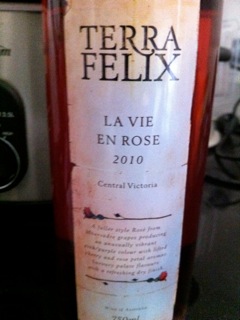
2010 Terra Felix La Vie En Rose

The Rose Revolution juggenaut rolls on with this predominantly mourvedre-based variety from the central Victorian Upper Goulburn Wine Region. Summer is a great time of year to imbibe in the diversity of roses available, seemingly produced now from every conceivable red grape variety and blends thereof. It is the perfect drink for Australia's outdoor lifestyle and warm climate.

I thought I'd focus on the 2010 La Vie En Rose because of its Mourvedre component, which makes up about two thirds of the wine with the remainder, Shiraz and Grenache. Our use of the varietal has been in the popular Grenache Shiraz Mourvedre (GSM) blends from the Barrosa Valley and McLaren Vale regions, so this rose is an interesting take on this blend. It is slightly more complex and vibrant in colour than its predecessor the 2009 vintage, made from one hundred percent Mourvedre grapes and one of only a few such expressions of Mourvedre rose in Australia at present.

Mourvedre is an ancient red grape variety that researchers believe was introduced to Catalonia in modern day Spain by Phoenician maritime traders around 500 BC. It later became known as Monastrell throughout Spain or Mataro after the city in the Catalan commune of Barcelona. Its migration to France during the 1500's took the variety to the Rhone Valley and Bandol on the Mediterranean coast in Provence where it found sanctuary during the late nineteenth century phylloxera epidemic. The Great French Wine Blight as it was known, devastated French as well as other European vineyards and drove Mourvedre almost to the point of extinction. It actually took until after World War II for sufficient vinestock to be developed and adapted to combat the parasitic louse. Mourvedre plays the primary component in the renown Bandol AOC roses and other red wines today.

Terra Felix sources its grapes from selected cool climate vineyards throughout the Central Victorian Region, an area that has granite and alluvial soils and continental climate similar to the Northern Rhone District. Their choice of grapes reflects an Australian take on the classic Northern Rhone varieties and is a homage of sorts to the terroir in this part of the Lucky Country.

A striking dark pink colour in the glass, the strawberry, cherry, rose petal and herbal aromatics give you the impression that a candied, fruity concoction lays in wait. Far from it. Dry, medium bodied and well balanced. Underlying Mourvedre savoury, earthy notes enhance the palate's crunchy red apple freshness and crisp acidity. A serious rose.

Relax and drink this rose chilled while listening to amongst other of her classics, the original La Vie En Rose sung by the La Petite Mome herself, Edith Piaf. Tawdry, newer versions such as Grace Jones' will never cut the mustard and will just have you reaching for the vodka bottle! 

Source: Retail Purchase. Rating: 88 Points. Website: http://www.terrafelix.com.au/

2010 Salena Estate Ink Series Bianco d'Alessano

There is always pleasure involved when you experience and enjoy something new for the first time. Without stating the bleeding obvious, I was thinking more along the lines of reading a book, hearing a piece of music, eating at a new restaurant or in particular drinking a bottle of wine!

It is all the more enjoyable when it happens to be a wine made from a rare grape variety that you have never heard of or experienced. With plantings at Loxton in South Australia's Riverland Region, Salena Estate is the only winery in Australia that produces wine from the Bianco d'Alessano variety. With a triple trophy haul at the recent Australian Alternative Varieties Wine Show, they should justifiably be proud of their 2010 vintage. It is an absolutely delicious drop!

Puglia is the stiletto 'heel' of Italy's boot and the region where this white grape variety originates. Historically, grapes and especially white wines from Puglia have gone under the radar, used in blends, for bulk wines and to make vermouth. Consequently, they were not taken seriously. Heavy Pugliese reds like Primitivo and Negromaro have had the limelight. Yet almost twenty percent of Italy's wines come from this region in the south-east, vying with Sicily as Italy's top producer. It is now the turn of the whites to grab some headlines and what I'm predicting is that southern Italian white varietals will be the next big thing on the Australian wine landscape.

Winemakers are now growing emerging varieties such as Vermentino, Fiano, Greco di Tufo and Bianco d'Alessano in Australia's warmer wine growing regions as a response to changing global weather patterns and earlier picking times. Whereas some grapes do not tolerate heat well, the ability of these particular varieties is renown for retaining that all important natural acidity until harvest. As Bianco d'Alessano is a late ripening grape, holding that crucial acidity level augurs well for the quality of the wine.

As the accolades acknowledged, the Salena Estate Bianco d'Alessano is a quality wine. In the glass it is pale straw yellow in colour. On the nose lovely nectarine and peach aromatics pop out as though you are about to eat a fresh fruit salad. Some citrus, delicate florals and minerality. On the palate a smoky citrus acidity supports the stone fruits. A good weight overall to the wine that finishes crisp and clean. Perfect as an appetiser but would really go well with fish. Do yourself a favour and broaden your tasting experience. An exciting discovery for the summer. 

Source: Winery Sample. Rating: 91 Points. Website: http://www.salenaestate.com.au/

2008 The Ritual Western Australia Viognier

The Ritual is a partnership between two Western Australian wine entrepreneurs whose vineyards are located in the Peel Wine Region, south-east of Perth. The wines made under the Ritual label were intended for an export market.

Gradually gaining a foothold out west, Viognier has the mainstream varieties Chardonnay, Semillon and Sauvignon Blanc to contend with in addition to varietals such as Chenin Blanc and Verdelho, which grow extensively in the soils and climate there to the point where Western Australia could reasonably be regarded as their spiritual home.

Having said that, Viognier has been a quiet achiever here but now appears to have become the trendiest of the Rhone Valley white wine trio as a stand alone, wanting a piece of the action as a reputable alternative variety. In recent years, small percentages of Viognier (usually around 5%) have been used to add fragrance and suppleness to the power of shiraz wines. Additionally, its use as a component in white wine blends, as a sparkling wine and as a late harvest variety highlights its versatility.


An ancient variety related to the Nebbiolo grape and possibly brought into France by the Romans, Viognier is the only grape permitted in the Northern Rhone appellations Condrieu and Chateau Grillet, two of France's smallest AOC's. Rescued from the brink of extinction in the late 1960's with the less than twenty hectares of vines planted in the world found in this region, it is documented that Eden Valley's Yalumba and its interest in the variety sparked its revival and the subsequent worldwide popularity. Yet despite its growth within France and the other major players California and Australia over the next four decades, it still remains a minor variety to this day.

There is a real mystique that accompanies this wine grape. The name may put people off, they'd rather stick to what they know. It's not only the facts that it was rescued from virtual oblivion, that Viognier has an unpredictable nature in the vineyard but also has unreliable yields that force winemakers to walk vinification tightropes to get the right balance between acid, sugar and alcohol levels. Adding to this headache is the fact that Viognier vines need a decade or two in order to develop and produce good wines. But when they do, the results are what Viognier is renown for: its stunning aromatics of fresh flowers, apricot and peach and the rich texture and tangy viscous palate that has been described as sensual.

The Ritual has restrained aromas of apricots and peaches with hints of honey and spice. In keeping with the age of the vines, it didn't have the palate richness but brought together a nice balance of citrus, stone fruit, pear and honey characteristics that lingered on the finish. The heat of the 15% alcohol content was disconcerting however.

With the ageing of the vines, it will be intriguing to follow up on future vintages. This was an inexpensive wine, good for its price that may get people interested in this variety as an alternative to the usual white wine suspects at the same price point. Viognier's aromatics and freshness are a great counterbalance to a diverse range of spicy as well as non-spicy foods. 

Source: Retail Purchase. Rating: 86 Points.

2008 Vinden Estate Alicante Bouschet


When you think about the Hunter Valley in New South Wales, wine may come up as a topic of conversation. When you talk about wine, Semillon, Shiraz, Chardonnay and perhaps Verdelho if you're in the know, may be the topics. Alicante Bouschet would not be on the radar.

Vinden Estate, a family-owned boutique winery in the Hunter Valley, has one of the limited plantings in Australia of this rare red fleshed grape variety. Irrespective of a grape's skin colour, the vast majority have clear juice and rely on skin contact and maceration to extract colour to therefore make into a rose. Few have dark flesh and juice like the Alicante Bouschet. The French call these types 'teinturier' a term meaning to dye or to stain.

Made into a rose, the Vinden Estate expression is vibrant bright pink in colour from its freely run pulp juice. Raspberry and strawberry aromatics predominate with hints of spice. On the palate dry, spicy fruit flavours and a nice acid tannin balance make this a lovely, soft, refreshing wine to drink chilled during the warmer months.

The Alicante Bouschet grape has a fascinating history. A French hybrid grape developed in 1865 by Henri Bouschet who was carrying on his father's work, it is the cross between the Petit Bouschet grape - the hybrid his father Louis had originally developed in 1824 - and Grenache. In effect, it was a double hybrid which winemakers planted widely throughout France - mainly in the south-west provinces - which they later used as a blending partner where colour and tannin was needed for lighter coloured wines.

Grown extensively throughout California too, its popularity - or perhaps notoriety - came during the American Prohibition era where its thick, tough skins resisted rot on the long cross country train journeys from their vineyards to east coast cities. Home winemakers and bootleggers it appears had field days obtaining two or three vintages from the thick skins and intensively coloured juice. Fruit growers transformed their orchards to take advantage of this high yielding grape and the lucre it generated. Once Prohibition was repealed, the grape was used for blending purposes, eventually falling in acreage and popularity. However, it still remains the most widely planted of France's teinturier grape varieties in France itself with plantings in other countries such as Spain, Portugal, Corsica, South Africa and Australia. Smaller areas now remain in California in comparison to its heyday during the Prohibition era.

Despite negativity about its overall character, its decline from favour in many wine growing areas and consumer demand for quality wines, the Alicante Bouschet grape appears to have experienced a raw deal throughout its existence, always the bridesmaid and never the bride, which is a pity. If the Vinden Estate is any example, I liked this rose very much and would not hesitate recommending it to people who wish to experience something different than what is on offer in the rose market today. 

Source: Winery Purchase. Rating: 88 Points. 
Website: http://www.vindenestate.com.au/

2009 Firebox Ridge Vineyard Selection Tempranillo

Made by the Australian winemaking and export company Winetrust Estates under its Firebox Ridge label, the 2009 Tempranillo is the first commercial release from its Swan Hill vineyards in northern Victoria and a winner of a number of awards at the 2010 Inland Winemakers Exhibition.

A long ripening season together with minimal vineyard intervention plus maturation in French and American oak has produced a modern Australian interpretation of this classic Rioja region varietal.

An attractive ruby red colour leads to a somewhat restrained bouquet of spice, vanillin notes and forest floor. It took time to elicit those aromatics as the nose was so tight. The same went for the palate as the profile of herbaceous wild berries, white pepper and chocolate notes didn't get started until the following night's libation. No amount of medical intervention could have revived this wine on the first night!

That said, this medium-bodied expression of Australian tempranillo is attractive and offers a long, pleasant finish with all the hallmarks of the variety. Do give it an airing before pairing it with any lighter style meat dish.

Source: Retail Purchase. 87 Points. Website: www.winetrustestates.com.au

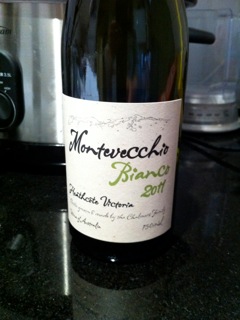
2011 Chalmers Montevecchio Heathcote 'Bianco'

There are some varietals that are compatible with each other and go on to have wonderful marriages. Western Australian Sauvignon Blanc Semillon blends are examples, as are the increasingly popular Shiraz and Viognier combination where the perfume of Viognier meets the power of Shiraz. Some marriages let's be frank, may not be a successful sum of their parts such as a recently tasted Verdelho, Viognier and Semillon blend that for me was lost somewhere in translation, perhaps better confined to the cardboard box variety of wine consumption.

The Montevecchio Bianco is a field blend of the Italian varietals Fiano, Vermentino and Moscato Giallo from the Chalmers vineyard at Heathcote and is one of the three wines in their Montevecchio range. The translation 'old mountain' refers to Mt. Camel and the ancient Cambrian soils that run through the Heathcote wine region in central Victoria.

The Chalmers family has pioneered southern Italian varietal wines at their Euston property in south-west New South Wales' Murray Darling region for the better part of a decade. The vines at their Heathcote vineyard were planted in 2009 with the inaugural release this year of a range of easy drinking wines under the Montevecchio label.

The Bianco is a superb blend of some of Italy's most ancient grape varieties grown in some of the world's most ancient soils and to me, a pleasure to experience for the first time.

Vermentino is a white grape variety grown in Sardinia and along the Ligurian and Tuscan coastlines and is known for its profile of savoury, herbal aromas, its dry, chalky palate and zesty preserved lemon characteristics.

A white grape variety that dates back to Roman times, Fiano grows predominantly around Avellino in the southern Italian region of Campania. A perfumed and appealing flavour profile, Fiano exhibits aromas of stonefruit, pears and apples with citrus fruit, toasted nuts and honey notes on the palate.

A clone of Muscat Blanc a Petits Grains, the Moscato Giallo (Yellow Muscat) is another ancient grape variety grown in the Italian regions of Friuli and Trentino-Alto Adige. It is renown for its intense musky, floral aromas and dry citric acid flavours.

This is an appealing wine that blends all of its component varietal parts into a harmonious whole and whose texture will marry well with a broad range of cuisine styles. The floral aromatics, the dry, tangy, honey zest on the palate leads to a long crisp, clean finish that should be a real crowd-pleaser for the upcoming warmer months.

Source: Retail Purchase. Rating: 90 Points. Website: www.montevecchio.com.au


2009 Tahbilk Marsanne

Consistently one of Australia's most popular white wines and always at a competitive price, the marsanne from the historic Tahbilk winery in central Victoria's Nagambie Lakes Region comes from plantings dating back to 1927. Indeed, Tahbilk claims to hold the largest, single holding of this, one of the world's rarest grape varieties.

The Marsanne grape arrived in Australia in the 1830's, was introduced into Victoria in the 1860's and now accounts for just over three quarters of its growth in the world. Without wanting to ruffle French feathers, it appears that this northern Rhone Valley varietal has found a more 'bountiful' home here in Australia.
In its native Hermitage AOC, Marsanne is the most widely planted white wine grape and is often blended with Roussanne. It forms the majority share in the white wines of the Hermitage, Crozes-Hermitage and St. Joseph's AOCs. Marsanne is also one of the eight grape varieties allowed in the Cotes de Rhone appellation. In Australia, it is also blended with the other of the northern Rhone white grape trifecta Viognier, to produce some really intriguing and award-winning blends.

Pale straw yellow in colour, this 2009 example is best served with roast chicken. More aged Marsanne can cope with heavier white meat dishes or even cheeses. It is indeed a versatile, food friendly white varietal that can and does stand the test of what father time throws at it.
A lemon, green apple nose is followed by a palate packing sweet spice, minerality and a dry, zingy acidity. Hints of pear and peach emerge with the familiar honeysuckle notes. Clean, fresh fruit flavours linger on the long finish.

This lovely, well-balanced, medium-bodied wine can be drunk now but could easily be put away for a decade to experience the golden hues and honeyed, nutty, dry fruit complexity associated with an aged Marsanne.

Source: Retail Purchase. Rating: 90 Points. Website: https://www.tahbilk.com.au/

2006 Rutherglen Estates Single Vineyard Nebbiolo

In its native appellation of Piedmont, Nebbiolo is renown for the production of Barolo and Barbaresco. Whether the name of the grape refers to its 'foggy' bloom - the Italian 'nebbia' - or to its 'nobile' origins is a moot point that could be argued over a glass or three of this aromatic, earthy red.

Nebbiolo has slowly started to get a foothold in the Australian wine landscape and there are some excellent examples around now despite early failures and the variety's reputation as a problematic grape to cultivate.

Aged for four years in old French oak to help balance the tannins and acid, this Rutherglen expression is crimson red to brown in colour with a bouquet of forest floor, tobacco, spice and leather. Somewhat tarty initially, the soft, medium bodied palate has loads of dark sour cherries, a hint of chocolate and oaky vanilla to bolster the firm tannic grip. The long, spicy finish is an invitation to pair with either a winter casserole or aged cheese.

There isn't the usual tar and roses complexity associated with an aged Nebbiolo but this is still a really good version of this emerging variety with the potential for a further 5-7 years cellaring. 

Source: Winery Purchase. Rating: 88 Points.  Website: www.rutherglenestates.com.au

2010 Zonte's Footstep The Love Symbol Savignin Blanc


You could be excused if you read this to be Sauvignon Blanc, or that it was a typo. All a bit confusing if you didn't know it was the French variety Savignin from the Jura region, a grape closely related to Traminer and not Sauvignon Blanc at all.

Most Australian producers do not use the Blanc on the label, leaving the Savignin to get people's attention and thereby lessening confusion. Pale straw in colour with citrus fruits and floral aromatics, this Savignin delivers crisp, stewed apples and minerals on the palate. It finishes soft, flavoursome and refreshing. A good example of this emerging variety to enjoy with seafood or on its own.

Until recent DNA testing proved otherwise, the Savignin grape was mistakenly thought to be the classic Spanish variety Albarino. Apart from the marketing nightmares, there was the issue of changing consumer thinking that it was neither Albarino nor Sauvignon Blanc that we were drinking.

One of the more original names for a winery, Zonte's Footstep in the Langhorne Creek wine region on the South Australian Fleurieu Peninsula, takes its name from a 19th century Zante currant vineyard that dried up with the present winery following in its 'footsteps'.
Langhorne Creek is regarded as one of Australia's oldest and possibly most underrated wine growing regions with the Love Symbol vineyard situated on a 40 million year old alluvial plain with the Savignin vines planted in maritime red sands sitting over pre-Cambrian era limestone.

That my wine loving friends makes the Heathcote Region's ancient Cambrian 'dirt' seem positively recent!

Source: Retail Purchase. Rating: 87 Points. Website: www.zontesfootstep.com.au

2009 Old Mill Estate Langhorne Creek Touriga Nacional

My first introduction to this dry, red Portuguese variety was at a favourite watering hole and as they say in the classics, the rest is history ! Bored with the usual offerings, sticking to my a b c diet, I thought I'd push the vinous education envelope and try the touriga. My only knowledge of the variety was its use in making vintage port. The truth be told, that's probably when I first experienced it, not knowing it was actually the touriga varietal.

Be warned winophiles, approach with care as there is an intense, brooding creature in the glass. A table wine of inky dark colours, concentrated dark fruit flavours, high tannins and a 14.5% alcohol content, it is initially shy on the nose but delivers a wallop to the unsuspecting novice once swirled.

Heady, tight, musky and fruity on the aromatics with plums, dark berries, spices and black tea providing an enormous structure to the palate. Yet an underlying smooth texture makes this wine so intriguing and appealing that it is difficult to ignore. A wine of contradictions, complexity, balance and length that has a considerable age-worthiness to it. No prizes in guessing this would complement hearty meat dishes. A real cracker of a wine !

Old Mill Estate was the first Australian winery to use touriga national to produce premium table wines and believed that the grape would thrive in the rugged, deep alluvial soils of the Bremer River estuary. Indeed, it would appear this variety has great potential in Australia to grow and produce quality table wines in conditions similar to the northern Douro and Dao regions of its native Portugal. 

Source: Retail Purchase. Rating: 92+ Points. Website: www.oldmillestatewines.com.au

2010 Yalumba Running With Bulls Barossa Tempranillo

Opaque, deep ruby crimson in colour with restrained aromas of spicy red fruit, maraschino cherries and mulberries. A hint of liquorice and chocolate rounds off the nose that improves with airing. The palate is medium weight with smooth, juicy, subtle oaky flavours and well balanced acidity with fine chalky tannins adding length at the tail end.

Tempranillo is a widely grown Spanish red grape that translates as "little early one" in reference to its short ripening period. Rioja and Ribera del Duero are the two main regions in Spain where Tempranillo dominates.

The Running With Bulls is sourced from numerous vineyards throughout the Barossa Valley and Penrice region. As a regional expression of tempranillo, this is an excellent wine with interesting fruit flavours but it may not show the real essence of the variety as its Wrattonbully cousin for example, which is sourced from different sites from the one vineyard.

Tempranillo is growing in popularity on the Australian wine landscape with its early ripening ability, potential and suitability to grow in both cooler as well as warmer environments. It will be interesting to compare its popularity to the Italian Sangiovese variety as its rival for hearts, minds - and palates - as the next big thing!

Source: Retail Purchase. Rating: 89 Points.


2010 Station Creek King Valley Sauvignon Blanc

Station Creek is a boutique winery located at Cheshunt in north east Victoria's cool climate King Valley, a region consistently producing quality traditional grape varieties as well as the emerging Italian varieties such as Pinot Grigio, Sangiovese, Nebbiolo and Arneis.

This pale green Sauvignon Blanc has subtle gooseberry, citrus fruits and tropical aromatics with green beans and passion fruit notes to add a little interest.

Fresh, crisp acidity on the palate with herbaceous characters give this elegant wine a satisfying and long finish.

Winemaker David Steer considers this to be his best production since the first vintage of Sauvignon Blanc in 1999.


This is definitely not the pungent Marlborough grassy fruit bomb we have come to experience nor does it have the rich complexity of for example, the Sorrenberg Sauvignon Blanc.

What it does deliver to the drinker is a refreshing, zesty dry wine that provides a different variation on the usual one dimensional Sauvignon Blanc theme. Serve this to accompany lightly crumbed fish flllets and lemon wedges. 

Source: Winery Purchase. Rating: 85 Points.

2008 Unsung Heroes Petit Verdot


Made by one of Australia's leading viticulturalists Geoff Hardy for a predominantly United States market from his Tractor Shed Wine range, the name reflects the underrated work of Petit Verdot, an unsung grape hero used to add richness, tannin and colour to

Cabernet Sauvignon based blends.

Petit Verdot is known as the ugly duckling of the five classic varieties permitted in the Bordeaux appellation and appears to be losing favour there as it struggles to ripen in the region's cooler climate.

This does not appear to be the case in Australia's warmer ripening conditions and our propensity to make stand alone varietal wines. The enthusiasm of winemakers has translated into increased plantings of Petit Verdot especially throughout South Australian wine regions and has highlighted the grape's suitability there and potential as a future rival to shiraz.

The fruit for this single varietal is a blend from vineyards in South Australia's McLaren Vale and Limestone Coast regions where climatic conditions are similar to both Mediterranean and Continental Europe.

Dark garnet in colour, intense and brooding things are going on in the glass. The violet, plum, blueberry and coffee aromas underline the fragrancy of the nose. The initial chewy, rich mouthfeel of plum and blueberry is slightly overtaken by the strong tannins and alcoholic heat (14.5%) on the spicy mid-palate. Silky textures throughout.
A long and pleasant finish completes this beautiful black swan. Nothing petit here winelovers!

This is a well made, tasty, powerful wine that deserves more recognition than it receives.
It would match red meat dishes very well. 

Source: Retail Purchase. Rating: 89 Points. Website: http://www.k1.com.au

2010 Rutherglen Estates Single Vineyard Arneis

Who said you couldn't drink Arneis during the cold winter months or any other white wine for that matter? We all need refreshing drinks but do we need to drink warming reds during this time? Matching this particular example from northern Victoria with either Italian fare or seafood dishes could be a pleasurable experience and a great alternative to the usual white wine suspects that pair well with these types of food.

The first Italian grape variety in the Rutherglen Estates portfolio and their fourth vintage according to the website, Arneis is the premium white wine from Piedmonte, also known under the synonym 'white Barolo' for its use in softening the aggressive tannic structure of Nebbiolo. Indeed, Arneis is the sibling white grape to the  red 'king' Nebbiolo and thrives in the chalky, sandy soils of its home in the Roero province of north-weestern Italy's Piedmonte region where it produces fragrant, harmoniously balanced wines of richness and freshness.

It's name in the old Langhe-Piedmont dialect translates as 'whimsical', 'stubborn' or 'little rascal', a reference to its capricious nature in the vineyard. Susceptible to poor yields, powdery mildew, low acidity, late ripening and easy oxidisation, this was a recipe for disaster even before the grape had been made into wine. To complicate matters further, in addition to a slew of regulatory factors impacting its growth and development as a varietal in Italy, Arneis came close to varietal extinction during the mid-twentieth century before dry white wines gained increasing popularity in the 1980's.

This is a refreshing, crisp dry white wine that doesn't really challenge the nose in terms of aromatics. It came across on the palate as light and citrusy, slightly herbaceous with the merest hint of pear and almond, some of the characteristics in its varietal flavour profile. But unfortunately, that was about it.

A good introduction to this variety, perhaps an alternative to Sauvignon Blanc for those looking for something a little different, but to me it was one dimensional and lacking in complexity or aromatics. I will look forward to reviewing other examples of this increasingly popular variety. 

Source: Winery Purchase. Rating: 82 Points. Website: www.rutherglenestates.com.au


2008 Rutherglen Estates Single Vineyard Sangiovese


Ruby red in colour. Intense sour cherry aromatics with tight layers of plum and cinnamon flavours integrate with fine, silky tannins to produce an elegant, food-friendly Sangiovese from 'little Italy' in Victoria's north east wine region.

This classic Tuscan varietal that forms the primary component of Chianti (Hannibal Lecter's favourite wine!), Brunello di Montalcino and the 'Super Tuscan' wine blends, takes it name from the Latin sanguis Jovis, 'the blood of Jove (Jupiter)'. It is Italy's most widely planted red grape variety and was introduced into Australia in the late 1960's.

The warm, juicy, earthy, dried herb characteristics persist on the palate and make this medium-bodied wine such a satisfying experience for either drinking now or medium term cellaring if patience is one of your virtues. Its fourteen months ageing in Hungarian oak hightens both the savoury fruit notes and the wine's length.

Prior to its recent, unfortunate closure the Rimefire Winery near Toowoomba in Queensland with its Tuscan-like terroir, produced one of my favourite Sangiovese varietals. The baton has now been passed on to this Rutherglen interpretation!

Try this impressive Sangiovese with tomato-based pasta and pizza dishes where the acidity and moderate alcohol levels would complement the food. 

Source: Winery Purchase. Rating: 88 Points. Website: www.rutherglenestates.com.au